The Real Cost of Software in the AI Era

There is an argument making the rounds in forums, podcasts, and tech threads that seems irresistible at first glance: with artificial intelligence, building software has become cheap, and anyone can build anything. Code has become a commodity.
There is a great deal of truth in that, but the mistaken part is assuming that code was the only bottleneck.
Anyone who has worked in development for a while knows that writing lines of code was never the only bottleneck. Some of the key bottlenecks are understanding what to build, why to build it, for whom, and how to distribute it so it can grow. Those questions still have no automatic answer, and that is exactly where the argument about the democratization of software still runs into real barriers.
What Building Software Really Involves
When someone outside the sector imagines the cost of software, they picture programmers typing code. That makes sense; it is the visible part, but it is only one part of the work.
In the past, the cost of developing the product was high enough to force rigor in the upfront analysis. The goal was to hand the developer a clearly defined problem so they could build without getting it wrong; otherwise, we would be wasting a scarce resource. Today that is no longer the case: you can prototype in hours and validate with users before making any serious technical commitment, and that is good. The problem is that the ease of testing does not eliminate the need to know what to test. Anyone who lacks clarity about the real problem will iterate quickly on aspects that are not worth testing, accumulating data without being able to extract value from it.
Once the code exists, another chain begins: distribution, user acquisition, retention, business model, pricing, positioning. None of that is solved by a code generator.
AI accelerated the tactile part of the work; the rest still demands breadth of knowledge, experience, and, above all, clarity.
The Real Cost of Coding with AI
Even in the part that AI truly helps with, the cost has not disappeared; it has been reduced and changed shape.
Using tools like Cursor or Claude Code to write code carries a direct cost in subscriptions or token usage, in addition to the cost of the time developers spend orchestrating, reviewing, correcting, and validating what was generated.
AI does not yet deliver production-ready code; it delivers code that needs to be validated. The difference between validated and unvalidated code can be expensive in security, scalability, and opportunity cost.
AI amplifies those who know what they are doing. In the right hands, it is a real productivity lever. In inexperienced hands, it accelerates the production of problems. The senior developer who uses AI delivers more and better. The beginner who uses AI without a theoretical foundation delivers more and worse.
This matters because the discourse around democratization ignores this asymmetry: it is not enough to have access to the tool; you need the grounding to use it with judgment.
Where Value Moves When Code Gets Cheap
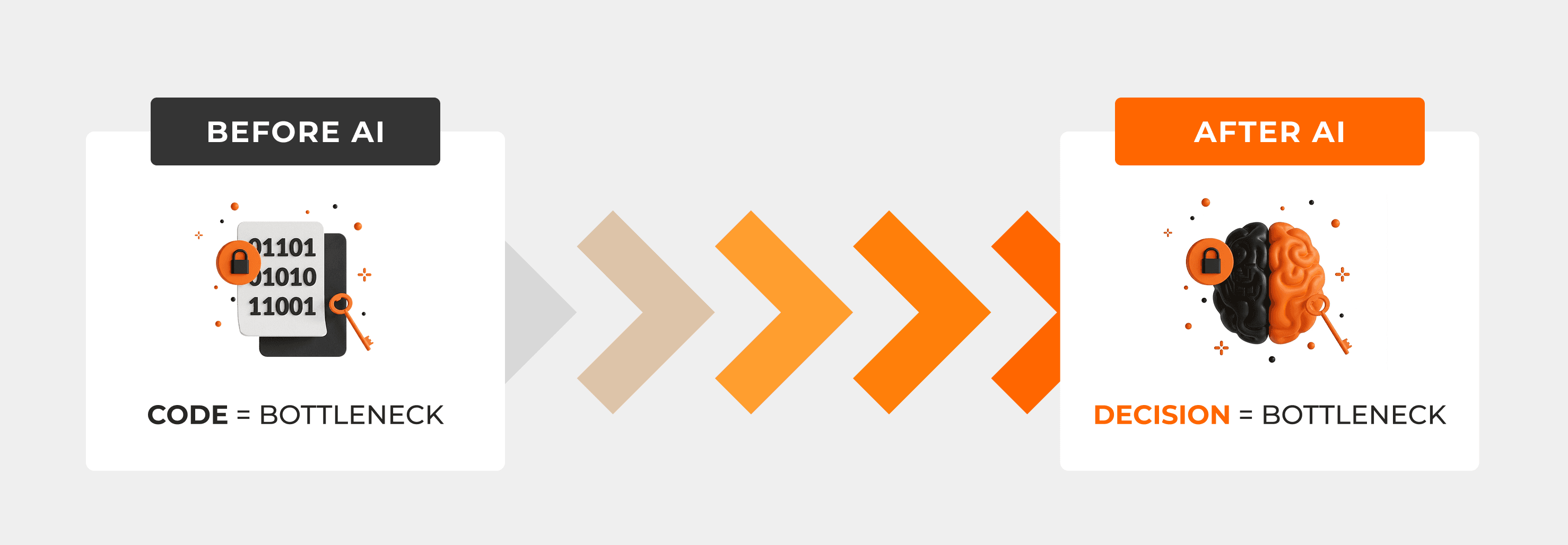
If coding becomes abundant, what becomes scarce in the development workflow? Building distribution, clear positioning, and figuring out how to reach those people efficiently and sustainably.
These capabilities have always been valuable. The difference is that when code was expensive, it functioned as a barrier to entry; whoever could build had an advantage simply because they had built. As that barrier falls, competition shifts to a plane where technical execution matters less and strategic discernment and distribution matter more.
This means that founders and product teams that clearly understand the market, know how to identify a real problem, articulate a precise value proposition, and build distribution channels even before writing the first line of code will enjoy an increasing advantage. Not because code stopped mattering, but because it stopped being a sufficient differentiator.
The software itself will rarely be the moat. The moat lies in who you serve, how you find them, why they stay, and what makes it difficult for a competitor to replicate not the product, but the position.
An Ocean of Similar Apps
A direct consequence of the democratization of coding is the proliferation of similar products. If anyone can build anything, many people build the same things.
Just look at saturated categories: productivity tools, task managers, analytics dashboards, AI assistants. The number of launches has grown. The real differentiation among them has not.
This is not a technology problem, but a strategy problem, because most of these products were built without clarity on why this product, for this audience, at this moment; they were built because it was possible to build them.
Technical possibility has never been product strategy and never will be.
Whoever stops competing on delivery speed and starts competing on the quality of decisions is playing a different game, and in the long run, a more advantageous one.
Conclusion
The argument that AI has lowered the cost of software development is true and incomplete at the same time. It lowered the cost of coding. It did not lower the cost of thinking, strategy, or distribution.
Understanding the right problem, making the right product decision, building distribution before you need it, positioning with precision - these capabilities still cost what they always have: time, experience, and clarity of thought.
What changes with the abundance of code is the relative weight of each capability. Whoever recognizes this shift in time will stop competing on speed, a race that has become impossible to win, and will start competing in the arena where differentiation is still possible: the quality of what they decide to build, and for whom.
Software has become easier to make; that makes judgment about what to make more important than ever.