Opportunity Turbulence: What Happens When Markets, Careers, and Wealth Reconfigure at the Same Time

There is a difference between change and rupture. Change is what happens when an industry evolves gradually, new players enter, processes are optimized, some roles disappear, and others emerge. Rupture is different: it does not respect the expected timeline, it gives no advance warning, and it does not distribute its effects evenly.
What we are living through now is a rupture at cruising speed, fast and forceful enough to be destructive and overwhelming, yet slow enough that most people still have not grasped the scale of what is happening.
We are at the beginning of a period in which the rules governing how value is generated, accumulated, and distributed will change profoundly. Assets, labor, professions, economic power, everything is being reconfigured at the same time.
I call this period Opportunity Turbulence. Not because it is comfortable, but because in recent history there has never been such a concentrated window for the reconfiguration of markets, careers, and wealth in such a short span of time.
The Map Being Redrawn
The speed at which specific capabilities are being automated does not follow the comfortable pace assumed by most professional trajectories. There is still time to move, but less than it seems.
This is not speculative projection. There are serious technical estimates, published by research labs, economic institutes, and the developers of the technologies themselves, placing dates next to specific capabilities. Some examples cited in the book Bitcoin One Million: 2027: medical imaging diagnosis more accurate than the average human radiologist. 2028: legal contract analysis outperforming a junior associate at a mid-sized firm. 2029: generation of functional code for most corporate demands without intervention from a senior engineer.
These numbers seem distant, but they are not. They are extrapolations of performance curves that are already underway. What bothers me is not the speed of change. It is the fact that most people will go through this period as passengers. They will feel the turbulence, adapt only as much as necessary, a certification here, a new tool there, and come out the other side in a better condition than they started, but relatively worse off than average.
The Economics of the Exceptional
There is something specific that almost no one is discussing honestly: artificial intelligence does not replace, for example, the exceptional doctor or the exceptional lawyer.
The average doctor, competent, up to date, without major technical differentiators beyond a diploma and accumulated experience, holds a valuable position today because the system has no other way to scale care. They are necessary because there is no alternative. When the alternative arrives, and it is arriving, the market logic that sustained their value disappears.
The exceptional doctor, the one whose clinical judgment goes beyond protocol, who integrates context in a genuinely superior way, who builds relationships of trust that no interface can replicate, begins to capture a disproportionate share of the remaining value. Because the market no longer needs to pay the average. It can concentrate everything at the top end.
This mechanism is not exclusive to medicine. It applies to lawyers: AI already produces legal briefs better than the average output of high-volume legal practice. It applies to programmers: automated code generation is compressing the value of the developer who merely translates requirements into lines of code. It applies to teachers, consultants, and financial analysts.
What is happening, in economic terms, is a compression of the middle of the professional pyramid. The top will survive, and probably prosper. The base will organize itself around functions that AI still does not master. The middle will virtually disappear.
Turbulence as a Filter

A storm does not destroy everything indiscriminately; rather, it reveals the fragilities that were already there.
What the convergence of AI, monetary reconfiguration, and market disintermediation is doing is making visible something that was always true, but that intermediary systems allowed to remain hidden: there is a huge difference between professionals who genuinely master what they do and professionals who operate within structures that shield them from real competition.
Lawyers who depend on notary offices to remain relevant. Doctors whose differentiator is access to equipment, not clinical judgment. Programmers whose position depends on access to project opportunities, not on programming exceptionally well. These protections are being removed, not by political decision, but by technological obsolescence.
What remains when the protection disappears is what you are truly worth.
That may sound brutal. But it is the most honest information the market has provided in a long time. You do not need a new certification or a career coach to understand what to do. You need, with a degree of honesty most people avoid, to answer a simple question: if I were competing today without any structural protection, without the diploma, without the title, without the institution that shelters me, what would I have to offer?
The answer to that question is your starting point.
What to Do About It
There is no manual for navigating a rupture while it is happening. But some readings of the moment seem more solid than others.
Stop treating adaptation as a side project. The idea that you can keep your main trajectory intact and just "keep up" with changes at the margins does not work in ruptures. Ruptures require a reallocation of focus, not an addition of focus.
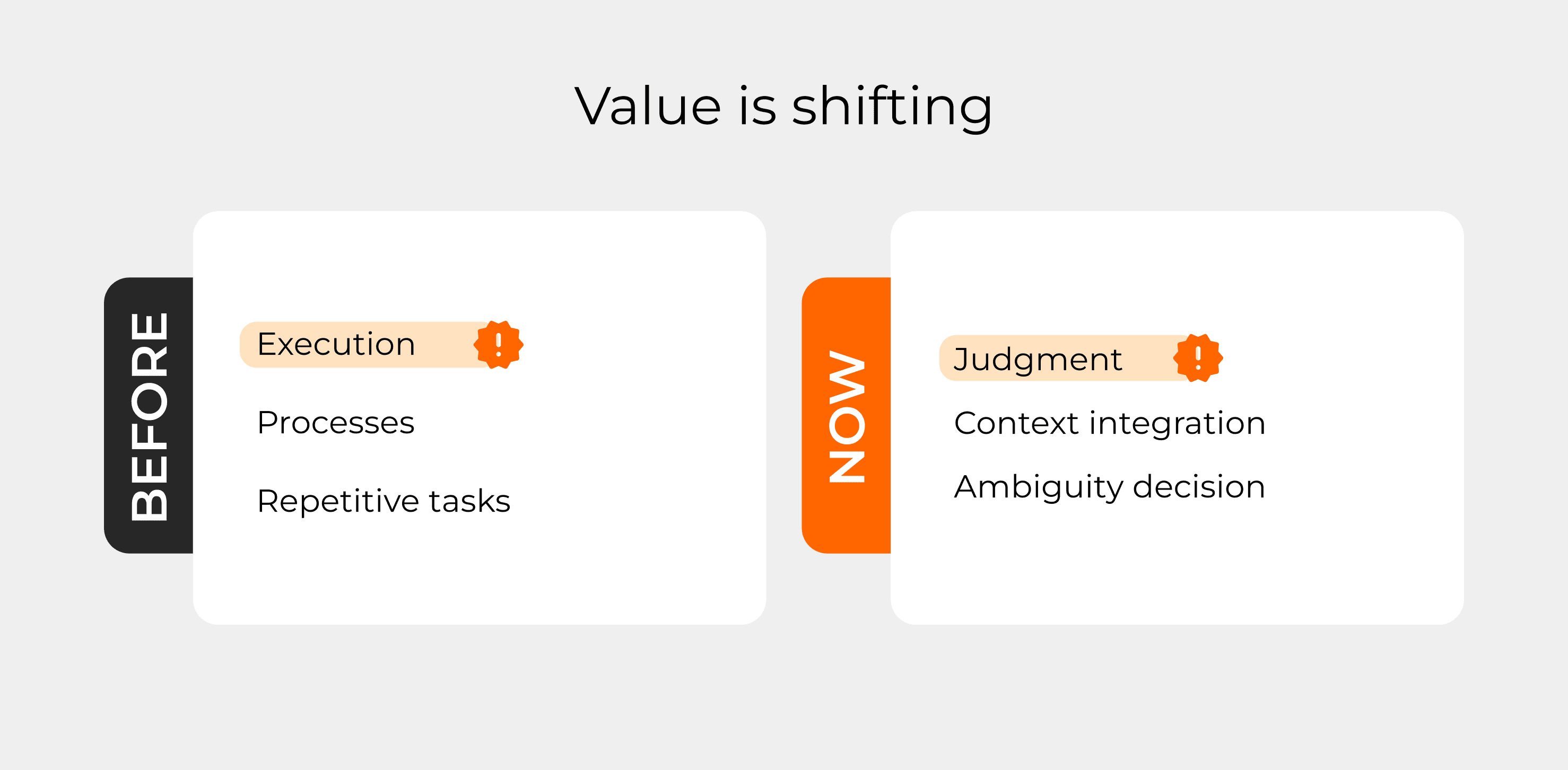
The differentiator that will matter is not technical skill, but judgment. AI tools are becoming good at execution. What remains genuinely human is the ability to define the right problem, to integrate context that is not explicit, and to make decisions under conditions of ambiguity. Those who develop this deliberately are building something that is not easily replicable.
Opportunity Turbulence is not uniform over time. There is a window, probably in the next two to three years, in which markets are still absorbing what is happening. That window will close. Positions of advantage will be taken. Those who move earlier will have options that those who wait will not.
And perhaps most important: do not confuse movement with direction. Many people will enter a frantic mode of learning, certifications, new tools, and career pivots without a clear reading of where value is migrating. Movement without direction is wasted energy at higher speed.
Conclusion
Opportunity Turbulence has already begun. It will not announce itself any more clearly than it already has.
What is at stake is not just employment or income. It is the relative position you will occupy in a market that is being redistributed in real time. In the last fifty years, there has never been a moment when so much value has moved in so little time and when the rules determining who captured that value were so open to revision.
Standing still or moving slowly while the ground is shifting has a cost. Assets lose value; professions disappear; people come out the other side with less than they had.
The relevant question is not whether you will be affected, but what you are building today and how honestly you are assessing what you truly have to offer.