Autonomous Era: The Structural Transition of Companies Toward Operational Autonomy

The history of human economic development is marked by major technological revolutions that not only introduce new tools, but profoundly reorganize how society produces, coordinates work, and creates value. The Agricultural Revolution enabled the transition from nomadism to sedentary economies, based on productive surplus, labor specialization, and hierarchical structures.
The Industrial Revolutions mechanized production, replacing human and animal labor with machines, new sources of energy, and standardized processes, giving rise to modern organizations and the logic of productive scale.
In the 20th century, the Information Revolution transformed data into a strategic asset. The digitization of processes and the spread of computers, software, the internet, cloud computing, and platforms connected people, companies, and markets at global scale, consolidating the digital enterprise, driven by systems, automation, and operational efficiency.
Now, we are entering a new structural rupture: the Autonomy Revolution, or the Autonomous Era. In this stage, Artificial Intelligence stops being merely a support tool, isolated automation, or incremental optimization and begins to assume functions of perception, reasoning, decision-making, coordination, and execution. Unlike previous revolutions, AI has become the central organizing element of productive operations, operating through autonomous and multi-agent systems that run continuously, adaptively, and with growing independence from direct human intervention.
The concept of the Autonomous Business gained institutional traction in 2025 with Gartner, which describes it as the next major transformation after the digital business era. According to Emerging Technology Vision 2025 and the Hype Cycle for Emerging Technologies, we are leaving a predominantly experimental phase of generative AI and entering an era of systems that “sense, decide, and act independently” (Gartner, 2025).
Strategic projections reinforce the materiality of this transition:
• By the end of 2026, approximately 40% of enterprise applications will incorporate dedicated AI agents, up from less than 5% in 2025.
• By 2028, organizations that adopt multi-agent AI across 80% of customer-facing processes will significantly outperform their competitors.
• By 2028, 90% of B2B purchases will be initiated, evaluated, or completed by AI agents. This transition is not speculative. It is driven by four converging and measurable forces:
• Intensifying global competitive pressure, especially from Asian and North American ecosystems already scaling autonomous agents in sales, supply chain, and support.
• A growing need for structural efficiency in a context of compressed margins and high macroeconomic volatility.
• Structural scarcity of qualified professionals: the talent deficit has ceased to be a problem restricted to technology and now affects multiple critical functions, operations, sales, customer service, analytics, management, and technology. In Brazil, Brasscom data indicates a significant shortage of IT professionals, but this number is only a slice of a broader phenomenon driven by demographic shifts, increasing organizational complexity, and the speed at which new competencies become necessary.
• Finally, technological maturation enabled by large language models (LLMs), intelligent agent frameworks, persistent memory, tool-use, advanced RAG, reinforcement learning, recursive language models, and simulation environments.
The Autonomous Era therefore represents a qualitative and structural shift in the relationship between humans, machines, and organizations, redefining not only processes and technologies, but the very operational architecture of companies.
The broader context of the Autonomous Era
The idea of autonomous systems has deep roots, from the first theoretical AI agents in the 1950s to the autonomy levels defined by the SAE J3016 standard (originally for autonomous vehicles, now used as a reference for general AI autonomy:
from Level 0,no automation,to Level 5, full autonomy in all scenarios). What changed was the convergence of generative AI, native integration with legacy systems, and multi-step planning capability.
Recent reports illustrate the momentum: Stanford HAI’s AI Index 2025 highlights strong growth in corporate AI adoption, with more than 78% of organizations already using AI in at least one business function (a significant jump versus prior years), and complementary research indicates that agentic AI is emerging as a top strategic pillar for most large companies.
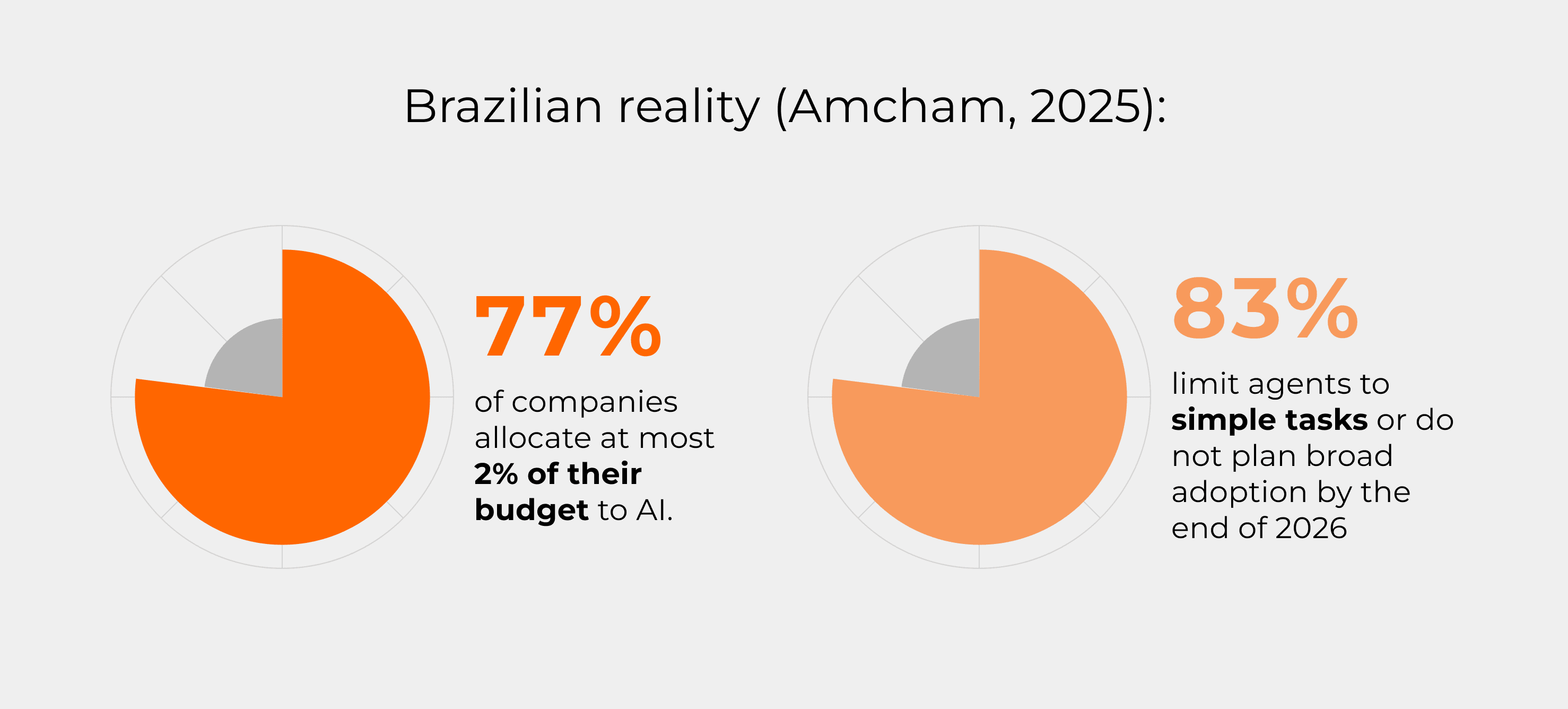
The impacts go beyond productivity: a redefinition of work models (humans as supervisors of “digital workers”), the emergence of “machine customers” (Gartner predicts 8 billion machines acting as customers by 2030), new regulatory dynamics (LGPD, the EU AI Act, future Brazilian laws on liability for autonomous agents), and deep ethical questions, goal alignment, decision transparency, algorithmic bias, concentration of technological power, and loss-of-control risks in high-autonomy systems.
The three phases of the transition
The journey is neither linear nor homogeneous. The phases coexist, but they mark clear progression in maturity.
Phase 1 — Intelligent process automation and applied AI
In this phase, AI augments human capabilities in specific tasks: intelligent document classification, advanced contextual chatbots, predictive churn analysis, real-time action recommendations, and many other real use cases.
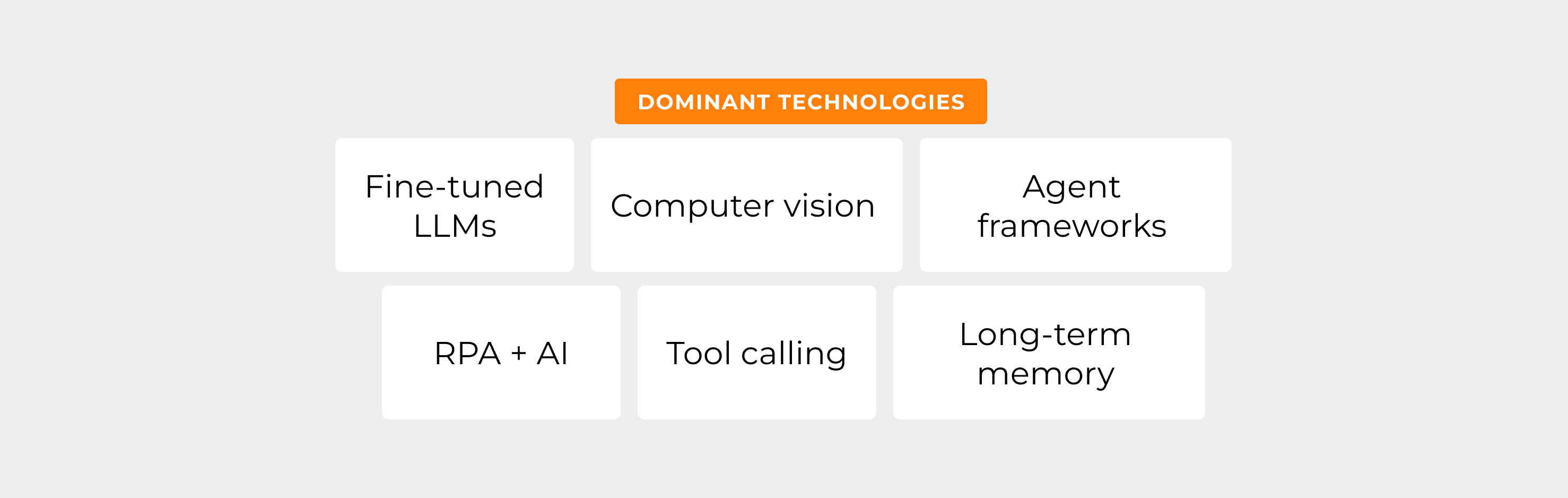
Gain: 30–60% reduction in manual effort in repetitive processes, but AI remains an auxiliary layer; the main flow is still human-orchestrated.
Phase 2 — Autonomous agents at scale and AI as a general-purpose technology
This phase is the structural inflection point of the Autonomous Era. AI stops acting only as support to human work and begins executing end-to-end workflows with supervised operational autonomy. Agents plan tasks, decompose objectives into steps, interact with multiple systems via APIs (ERPs, CRMs, data platforms, internal tools), make decisions within defined guardrails, learn from results, and collaborate in multi-agent architectures.
These agents operate continuously, handle simple exceptions, prioritize actions, and coordinate dependencies, while humans take on supervisory roles, setting objectives, validating limits, and analyzing critical cases. AI begins to function as a general-purpose technology, comparable to electricity or enterprise software, becoming embedded across business processes.
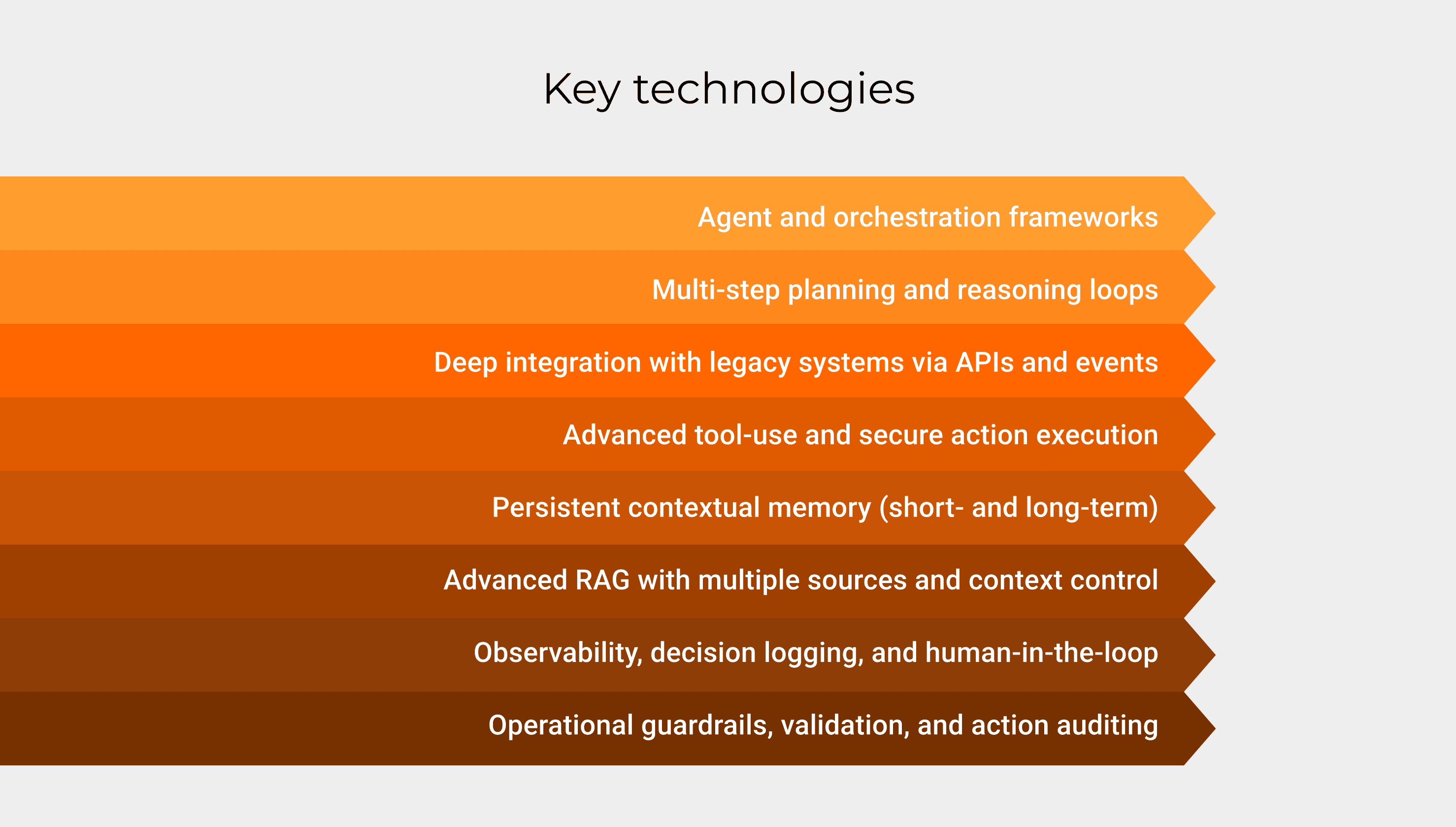
Typical impact:
• Autonomous execution of complete processes (e.g., sales, support, internal operations)
• Significant reduction in operational cost
• Increased response speed and adaptability
• Human role shifts from executor to orchestrator and supervisor
Phase 3 — Autonomy at the core of the business
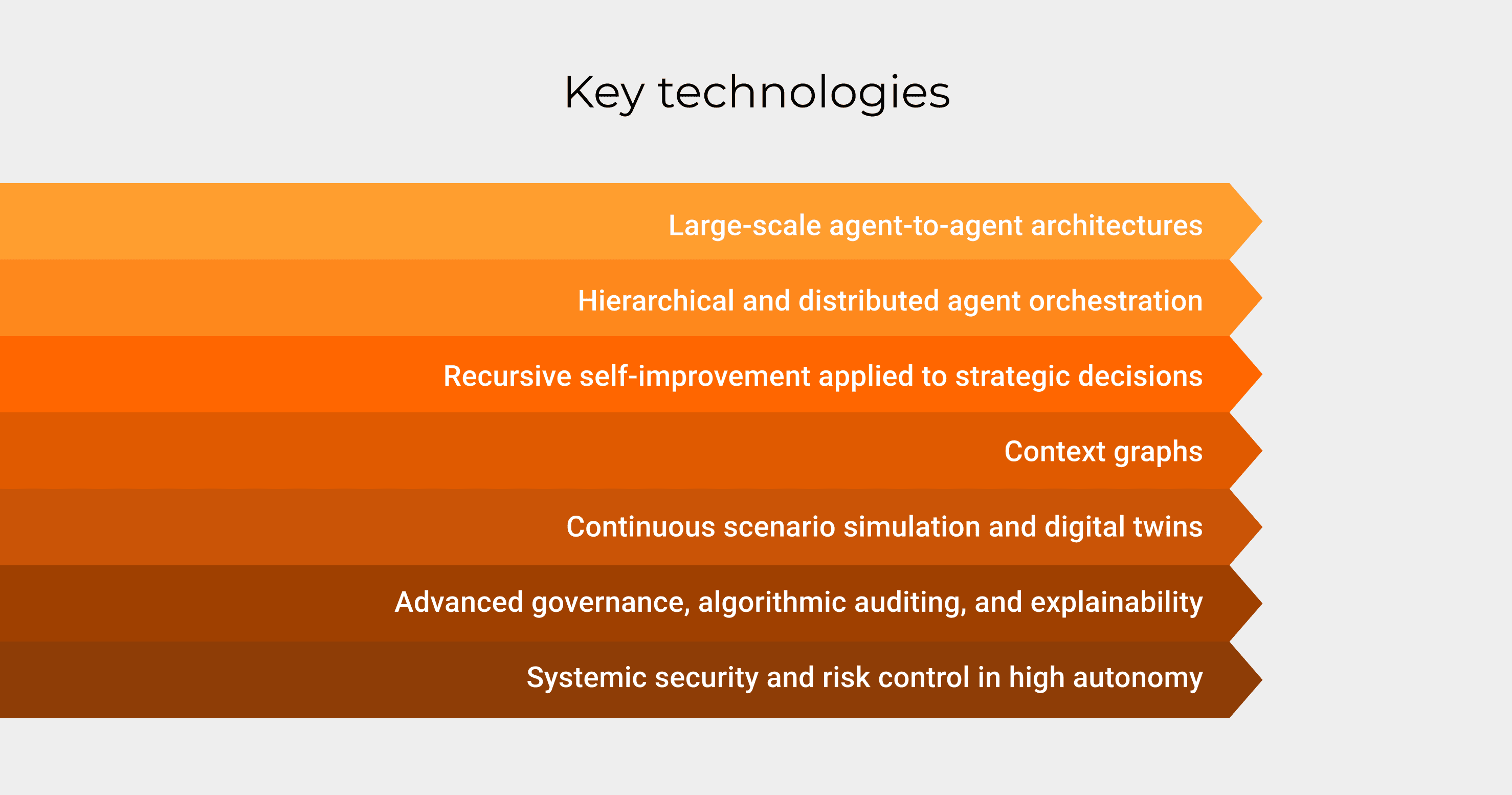
In the third phase, autonomy stops being an attribute of isolated processes and becomes the central organizing principle of the business. Products, services, and operations are born natively autonomous. The company is redesigned around AI orchestrators coordinating ecosystems of specialized agents, operating in agent-to-agent architectures with minimal day-to-day human intervention.
At this stage, systems not only execute tasks, but learn, adapt, and evolve strategically over time. Recursive self-improvement techniques are applied at higher levels of the organization, such as optimizing operational strategies, dynamically allocating resources, and making decisions under uncertainty. Context graphs allow agents to maintain a continuous understanding of business state, decision history, competitive environment, and regulatory constraints.
Human intervention concentrates on high-level decisions: defining strategic objectives, radical innovation, ethical governance, auditing critical decisions, and resolving complex exceptions. Competitive advantage lies not only in technology itself, but in the organizational capability to design, align, audit, and responsibly evolve autonomous systems.
Where we are today
The three phases describe a clear direction of evolution, but the journey is still underway. Most organizations operate with initiatives concentrated on intelligent automation and experiments with AI agents. The truly autonomous company is not yet a consolidated reality; it is a stage under construction that requires technological maturity, solid governance, and structural redesign of operations.
Reconfiguring companies’ operational architecture
The Autonomous Era does not transform only tools or isolated processes; it imposes a deep reconfiguration of organizational operational architecture. The prevailing model of recent decades, based on linear processes, centralized human decisions, and passive systems that merely execute instructions, becomes progressively inadequate in environments marked by high complexity, speed, and uncertainty.
As autonomous agents plan, decide, and act, the organization stops being structured only around traditional functional flows and begins operating as a distributed intelligence system in which multiple agents, human and artificial, coordinate actions in real time.
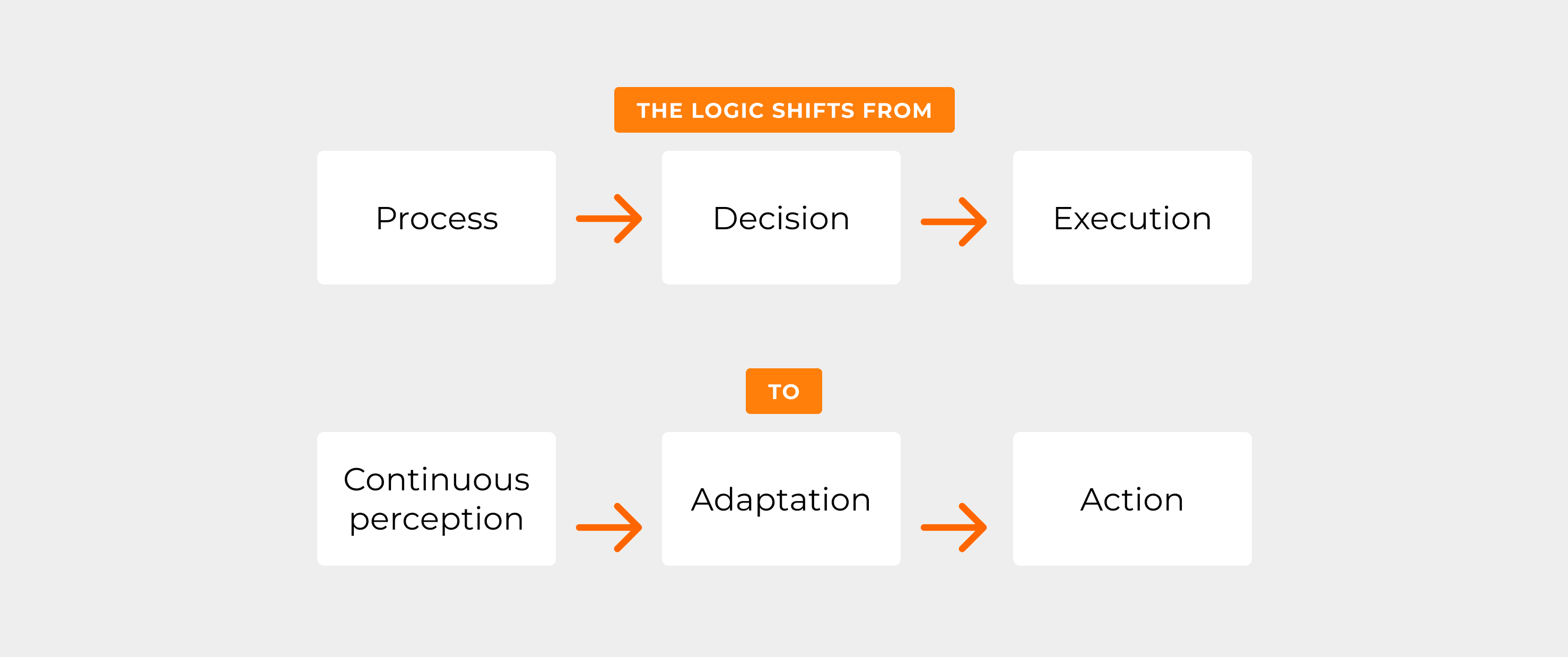
This change shifts the center of gravity of operational efficiency. The gain is not only task automation, but the capacity to respond dynamically to context, anticipate events, test scenarios, and continuously adjust decisions, something unfeasible in strictly human-orchestrated architectures.
New bottlenecks and new organizational capabilities
As automation and AI-assisted coding drastically reduce implementation effort, the main organizational bottleneck moves from technical execution to the ability to design, govern, and evolve autonomous systems.
New structural challenges emerge:
• Architecting adaptive systems capable of operating under uncertainty
• Secure and reliable integration with legacy systems and critical data
• Agent governance, decision observability, and action traceability
• Security in autonomous environments, including risks like prompt injection, data leakage, and emergent behaviors
• Ethical alignment and objective control in high-autonomy systems
• Consistent measurement of real business impact beyond technical metrics
These challenges require capabilities that go beyond traditional engineering. Designing autonomous systems implies combining software engineering, data science, systems theory, governance, compliance, and business strategy into a single operational discipline.
From operational efficiency to measurable impact
In the Autonomous Era, efficiency stops being only cost reduction or isolated productivity gain. The focus shifts to measurable and continuous impact on strategic outcomes such as operational resilience, adaptation speed, decision quality, risk reduction, and the ability to scale operations without proportional growth in human effort.
Well-designed autonomous systems do not just execute tasks faster; they:
• Reduce operational variability
• Anticipate failures and exceptions
• Learn from the environment
• Adjust strategies in short cycles
• Sustain gains over time
Value is generated by the system’s capability for continuous evolution, not only by the initial technology delivery. Organizations that internalize this logic can turn autonomy into sustainable competitive advantage, while those stuck in static models tend to accumulate complexity, cost, and operational fragility.
Challenges, risks, and critical considerations
The transition brings significant risks that require active management:
• Lack of trust: only 27% of executives fully trust agents (recent studies)
• Bias perpetuated at scale: automated decisions can amplify existing prejudices
• Security vulnerabilities: multi-agent systems introduce new attack vectors
• Employment impact: displacement of routine tasks
• Regulatory and ethical challenges: liability for agent errors
• High initial cost: governance and observability require significant investment
Preparation requires investment in hybrid talent (technical + business + ethics), AI governance frameworks, simulated testing environments, and a culture of controlled experimentation.
Conclusion
The Autonomous Era is not a distant horizon; it is a trajectory already accelerating in 2026, driven by concrete technological advances, economic pressures, and talent scarcity. Companies that see it as a structural transformation, rather than just another passing tech wave, will build sustainable competitive advantage in a world where autonomy, distributed intelligence, and AI-driven coordination define the winners.
The central challenge is not only adopting tools, but deeply rethinking operating models, organizational structures, technology contracts, success metrics, and the human role in the enterprise.
Those capable of turning technology into real results, ethically, responsibly, measurably, and aligned to strategic business objectives, will not only survive the Autonomous Era; they will lead the next cycle of prosperity.